Recording Area Annual Totals

97 Species in 2013, 99 in 2012, 94 in 2011, 108 species were recorded in 2010;


Tuesday, 8 October 2013

A Finnish-ringed BLACK-HEADED GULL in Lowndes Park

TUESDAY 8 OCTOBER
 
With temperatures still high at around 18 degrees C, it was another pleasant day out in the field. Although largely overcast, it remained dry throughout, with a moderate SW breeze.


 No sooner had I got out of bed than Mike Campbell had discovered a GREAT WHITE EGRET at WILSTONE RESERVOIR (TRING) - either the Tyttenhanger GP bird relocating or that from Otmoor. Battling my way through the Chesham morning rush-hour, I eventually arrived on site at 0830 hours - Mike informing me that the bird had disappeared! Just he and Stuart Wilson had seen it. He had last seen it disappear into the NE corner of the SW sector so I wandered down to the jetty and Cemetery Corner to check from there. There was a much smaller number of wildfowl present than from yesterday, although 16 NORTHERN PINTAIL was still a good number. Little Egrets numbered 14 and many were stalking together in the shallows - no GWE with them though. A single SCANDINAVIAN ROCK PIPIT was in the bay thereabouts but flew quickly towards the hide whilst 8 Meadow Pipits and a SISKIN flew overhead.
 
The Orchard area produced a feeding flock of small birds including the 2 MARSH TITS that had so far eluded me all year, 12 Long-tailed Tits and 2 Common Treecreepers, whilst Great Spotted Woodpecker and a pair of BULLFINCH were also added - but still no sign of the egret.
 
I started to walk back along the East Bank and just as I was about to reach the car park steps, I espied the GREAT WHITE EGRET flying in from the east landing out of view in the same area as Mike Campbell had earlier described. I rushed around to the Drayton Bank Hide and after a while, Rose Collard picked it up walking out from the south side of the spit. It afforded some excellent views for a short while before it was repeatedly flushed by a Grey Heron. This behaviour continued all morning and almost every time the GWE landed and proceeded to fish, it was hounded out of town by the Grey Herons. They really didn't like it. Over the next hour, the Great White touchdowned in almost every corner of the reservoir and had a particular penchant for the isolated lagoon in the NW sector. I was able to take a lot of images over this time but at 1145 hours, a Grey Heron suddenly hastened its departure, chasing it from the old outfall all the way to over Stuart's house in Drayton Beauchamp (Bucks airspace). We thought it had gone but just over 15 minutes later, John Edwards phoned to say that it had returned to Cemetery Corner. As expected, it was quickly moved on from here, and was forced to return to by the hide - eventually walking the entire distance of the Drayton Bank into the middle of the reservoir. It remained on show until 1448 hours, at which time it was chased and forced to retreat to the channel to the right and behind the hide. It was seen by about 20 observers before it disappeared, the bird not reappearing before dusk (per Francis Buckle & Chris Rockell).
 
Otherwise, little different from yesterday's visit - the 2 juvenile RUFF, the 4 BLACK-TAILED GODWITS. the juvenile RINGED PLOVER and the 28 EUROPEAN GOLDEN PLOVERS, a COMMON KINGFISHER, GARGANEY, a female Sparrowhawk and a migrant juvenile Common Buzzard; Mute Swan '4AFC' was espied again too.
 

Heading back home through CHESHAM, I checked LOWNDES PARK LAKE again, where Atlantic Canada Geese have reached pest proportions. No less than 540 of them are grazing daily, roosting each evening at Stockers Lake (Rickmansworth). Muscovites numbered 7 whilst foraging/scavenging Black-headed Gulls included a ringed adult from FINLAND (3727833) and another from the UK (ST229111).


Lowndes Park CANADAS

The flock of ATLANTIC CANADA GEESE in Lowndes Park in Chesham has now risen to a ridiculous 539 birds - the largest number ever recorded in the Chess Valley.

Chris Pontin had 8 Meadow Pipits in Chesham at Hill Farm whilst 1-2 Little Egrets are back in the valley.

Friday, 27 September 2013

Lowndes Park Lake inventory

FRIDAY 27 SEPTEMBER
 
Another Indian Summer-like day with clear blue skies, long periods of sunshine and temperatures in the high 60's - wind light easterly too, gradually increasing by dark
 
At WILSTONE RESERVOIR (HERTS), there had been a large increase in wildfowl - most notably in 14 PINTAILS - the highest number in many years. Also 270 Eurasian Wigeon, 460 Common Teal, 146 Shoveler, 21 Gadwall and 216 Northern Pochard, as well as the 45 Mute Swans (including adult '479'). and the two long-staying GARGANEYS.
 
Waders were poorly represented with just 4 BLACK-TAILED GODWITS remaining and 206 Lapwing, whilst 4 HOBBIES remain, 11 Little Egrets and 18 Sinensis Cormorants; a Jay was on the East Bank.
 
TRINGFORD RESERVOIR held all 7 Mute Swans (the 5 cygnets still surviving) whilst the 2 adult WHOOPER SWANS were quickly seen off by the cob Mute, while MARSWORTH held just 2 Great Crested Grebes.
 
STARTOP'S END RESERVOIR was still looking attractive in the SW corner and harboured 3 first-year LITTLE GREBES, 7 Great Crested Grebes (including the 4 juveniles), 172 Coot, 2 Wigeon, 1 Shoveler, 4 Teal, drake Gadwall, 63 Tufted Duck and 12 Moorhen. Sadly, this adult Great Crested Grebe was dead on the mud.
 
On my way home, an inventory of CHESHAM'S LOWNDES PARK revealed the presence of 298 Atlantic Canada Geese and 8 Muscovy Ducks.


A Moorhen sunning itself


A pretty Muscovite


.....and an excellent opportunity to photograph both first-year and adult Black-headed Gulls


Tuesday, 24 September 2013

Just in the nick of time - HOBBY added

Seems like I am the only one posting on this group......idea was for more input....hay-ho
TUESDAY 24 SEPTEMBER
Summer seems to have returned with temperatures this afternoon reaching a balmy 24 degrees C. Light winds throughout and clear skies but thick fog over part of the area until mid morning....


 At home in the garden, 4 BULLFINCH visited the Sunflower Heart feeder for about 20 minutes around 0900 hours whilst over at WILSTONE RESERVOIR (TRING), a full inventory went like this........
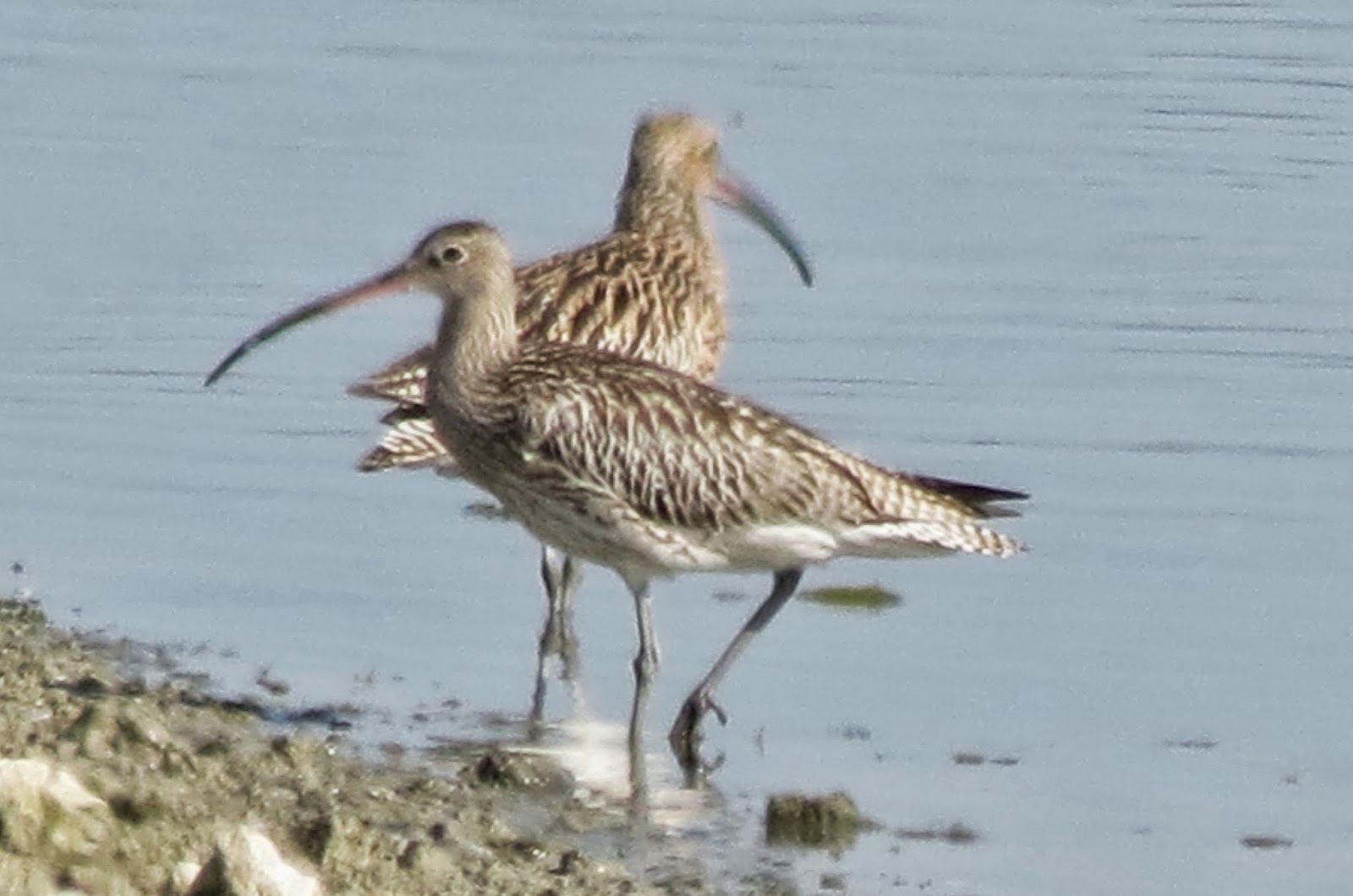
Highlight was a party of 4 EURASIAN CURLEW and single BLACK-TAILED GODWIT that arrived noisily from the east at 1209, not that long after the fog had cleared. After a few flyarounds, they eventually came down on the Drayton bank and were still present after I had walked round to the hide from the jetty. I was able to take a large number of images (see immediately below) before they finally flew off strongly SSW at 1316. Bill Pegram, JT and Ken Simmons all connected.


Great Crested Grebe (15 - including the 2 juveniles)
Little Egret (10)
Grey Heron (3)
Mute Swan (45)
Greylag Geese (78)
Mallard (260)
Common Teal (535 - large increase)
Eurasian Wigeon (135 - increase)
Gadwall (29)
NORTHERN PINTAIL (4 present - 3 drakes and a female - my first of the autumn)
Northern Pochard (146)
Tufted Duck (not counted)
Red-crested Pochard (2, with both juveniles still surviving on Tringford too)
Red Kite (5)
Common Buzzard (6)
HOBBY (at least 3 still present)
WATER RAILS (8 along SE shore and another by the hide)
Coot (down to 501 birds)
BLACK-TAILED GODWIT (still 4 juveniles present whilst an additional bird arrived with the Curlew)
COMMON GREENSHANK (long-stayer still present in Cemetery Corner)
Common Kingfisher (2)
Great Spotted Woodpecker (1)
Meadow Pipit (slight passage - 4 birds)
Grey Wagtail (4)
Mistle Thrush (2)
LESSER WHITETHROAT (3 - 2 in the East Hedgerow and another in the orchard)
Blackcap (male in the orchard)
Long-tailed Tit (roving flock of 16 in wood behind hide)
Chaffinch (light passage - 5 birds noted)
Bullfinch (pair in the orchard)
WEEDONHILL WOODS, NEAR HYDE HEATH (BUCKS)

Just in the nick of time, HOBBY was added to my Recording Area Yearlist, with a family party of 4 birds hunting over the wood (Don Stone had 5); also Sparrowhawk, 11 Common Buzzard, 15 Red Kite and 28 Stock Doves, with 6 Barn Swallows through.


An array of Common Buzzards were in the air including the very white individual photographed above


Many Red Kites also


This juvenile Linnet was hungry


....whilst this tree held both the Great Spotted Woodpecker and Stock Dove above